
Introduction
When building or renovating a home in Pune, choosing the right wall plaster is more important than it may initially seem. Plaster does much more than create a smooth surface for paint. It protects walls, influences moisture movement, affects indoor comfort, and contributes to the overall appearance and longevity of a property.
Traditionally, cement plaster has been the standard choice for residential and commercial construction. It is widely available, familiar to contractors, and offers a strong and durable surface. However, homeowners and designers are increasingly exploring alternatives that offer better moisture management, natural aesthetics, and environmental benefits.
One such option is lime plaster.
So, when comparing lime plaster vs cement plaster, which one is better for Pune’s climate?
The answer depends on the building, location, exposure to moisture, desired finish, maintenance expectations, and architectural style. However, Pune’s seasonal changes—particularly its hot summers and intense monsoon—make properties particularly interesting candidates for breathable wall finishes.
Let’s take a closer look at how lime plaster and cement plaster compare and which may be the better choice for different Pune homes.
Understanding Pune’s Climate and Its Impact on Walls
Pune experiences a climate with significant seasonal variation. Summers can bring considerable heat, while the monsoon introduces high humidity, heavy rainfall, and prolonged periods of moisture.
These changes can place stress on building walls.
During the monsoon, moisture can enter walls through external exposure, cracks, joints, poorly protected surfaces, or other vulnerable areas. If moisture becomes trapped within a wall assembly, it can contribute to damp patches, paint deterioration, peeling finishes, mould growth, and unpleasant indoor conditions.
This is where the concept of breathable wall plaster becomes important.
A breathable plaster allows water vapour to move through the wall rather than unnecessarily trapping moisture behind an impermeable surface. The objective isn’t to allow rainwater to freely penetrate the wall—it is to help manage and release internal moisture vapour appropriately.
This difference is one of the major considerations when evaluating lime plaster vs cement plaster.
What Is Lime Plaster?
Lime plaster is a traditional wall-finishing material made primarily using lime, aggregates, and water. Lime-based construction has been used for centuries in different parts of the world because of its flexibility, workability, and ability to interact naturally with masonry.
Unlike some modern finishes that form a highly rigid surface, lime plaster can accommodate small movements within a building. This can be particularly useful in older structures and certain masonry systems.
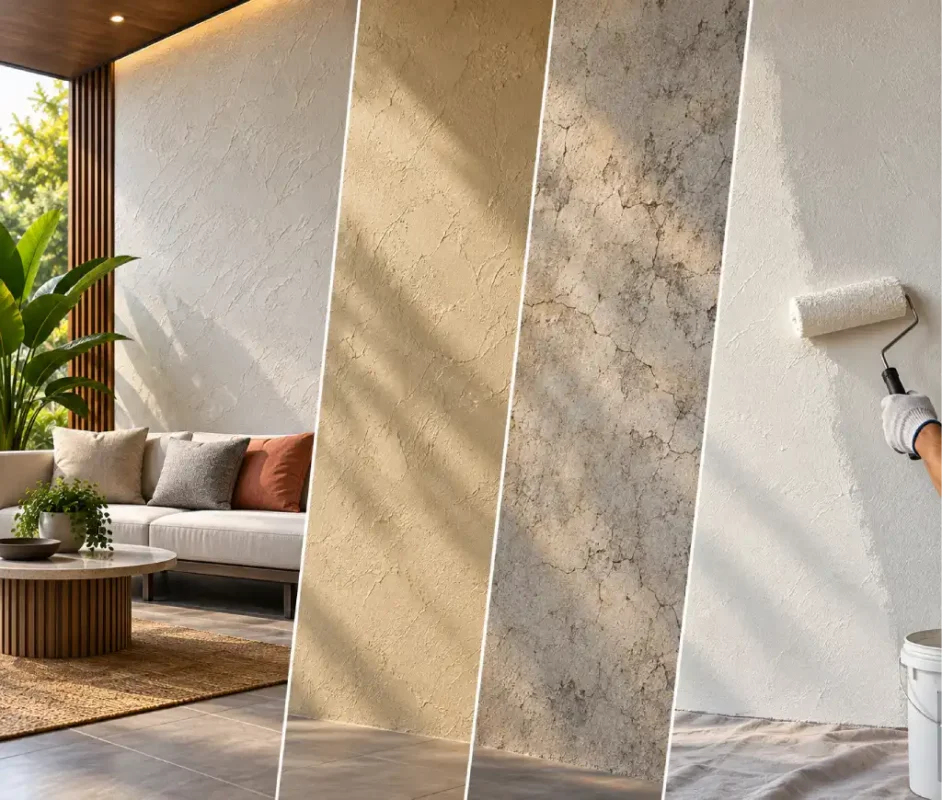
Modern lime finishes can also offer a distinctive, soft and natural appearance that is difficult to replicate with conventional cement-based surfaces.
For homeowners interested in natural materials, restoration projects, sustainable construction, or character-rich interiors, lime plaster can be an attractive option.
What Is Cement Plaster?
Cement plaster is a cement-based mixture generally combined with sand and water to create a strong coating over masonry or concrete surfaces.
It has become one of the most common plastering systems in modern construction because it is:
- Widely available
- Familiar to contractors
- Strong and relatively rigid
- Suitable for many conventional construction applications
- Compatible with numerous finishing systems
- Generally cost-effective for large-scale construction
Cement plaster provides a robust base for subsequent finishes such as paint, texture coatings, and other decorative treatments.
However, its rigidity and relatively low vapour permeability can become important considerations when moisture management is a concern.
Lime Plaster vs Cement Plaster: Key Differences
The easiest way to understand the difference is to compare them based on the factors that matter most to Pune homeowners.
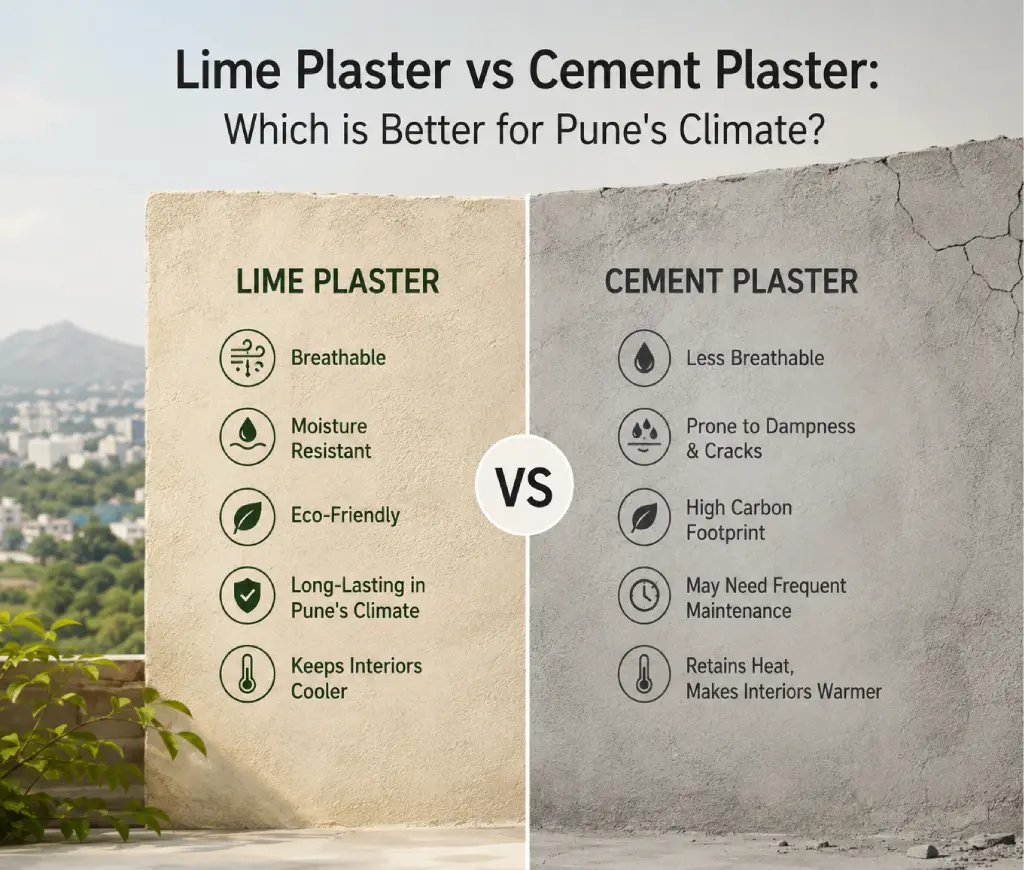
| Factor | Lime Plaster | Cement Plaster |
| Breathability | High | Relatively low |
| Moisture management | Excellent vapour movement | Can trap moisture depending on wall system |
| Flexibility | More flexible | More rigid |
| Natural appearance | Soft, organic finish | Conventional, uniform finish |
| Environmental impact | Generally lower | Higher embodied energy |
| Traditional buildings | Excellent choice in many cases | May be unsuitable for some older masonry |
| Modern construction | Suitable in selected applications | Widely used |
| Maintenance | Requires suitable finishing and care | Generally familiar and straightforward |
| Aesthetic appeal | Natural and textured | Smooth and conventional |
| Sustainability | Strong advantage | Comparatively lower |
The right choice ultimately depends on how these characteristics interact with your specific property.
1. Breathability: A Major Advantage of Lime Plaster
One of the biggest lime plaster benefits is its breathability.
Lime-based plaster can allow water vapour to migrate through the wall system. This is particularly useful in buildings where moisture movement needs to be carefully managed.
Imagine a wall exposed to humid monsoon conditions. Moisture vapour can naturally move through building materials. If a coating significantly restricts this movement, moisture may accumulate within the wall or at the interface between materials.
A breathable finish can help reduce this risk by allowing vapour to escape.
This doesn’t mean lime plaster should be treated as a waterproofing solution. Proper waterproofing, drainage, roof detailing, plumbing, and building maintenance are still essential.
But when the problem involves vapour movement, a breathable plaster system can offer an important advantage.
2. Cement Plaster Offers Strength and Familiarity
Cement plaster remains popular for good reasons.
It provides a strong, hard surface and is widely understood by architects, contractors, masons, and homeowners. For new residential construction, it is often incorporated into standard construction specifications.
It also performs well in many applications where a rigid, durable surface is desirable.
The challenge arises when cement plaster is used indiscriminately in situations where the wall needs greater moisture permeability or flexibility.
For example, applying a rigid cement-based coating to certain older masonry structures can create compatibility problems. Different materials respond differently to temperature and moisture changes, and excessive rigidity can contribute to cracking in some situations.
Therefore, cement plaster isn’t necessarily “bad.” It simply isn’t universally suitable for every wall.
3. Lime Plaster and Pune’s Monsoon
Pune’s monsoon season makes moisture management an important consideration for homeowners.
Heavy rainfall can expose exterior walls to significant moisture. Poorly maintained surfaces, cracks, leaking roofs, damaged plumbing, or inadequate drainage can make the situation worse.
Lime plaster can be advantageous in suitable wall systems because it allows greater vapour permeability.
However, homeowners should remember an important distinction:
Breathability is not the same as waterproofing.
If your home has active water leakage, rising damp, plumbing problems, or structural cracks, simply applying lime plaster will not solve the underlying issue.
The source of moisture needs to be identified and corrected first.
Once the building envelope is properly protected, a breathable finish can complement the overall moisture-management strategy.
4. Lime Plaster Can Be More Flexible
Buildings naturally experience small movements due to temperature fluctuations, settlement, moisture changes, and material expansion and contraction.
Lime plaster has a degree of flexibility that allows it to accommodate minor movement better than highly rigid coatings in many traditional applications.
This characteristic can be particularly useful when working with older buildings.
Pune has a mix of modern apartments, independent homes, traditional houses, restored properties, and heritage-inspired architecture. For older masonry buildings, material compatibility is particularly important.
Using a plaster that is too rigid compared with the underlying masonry can potentially create cracking and deterioration.
This is one reason why lime-based materials continue to be considered for restoration and conservation work.
5. The Natural Lime Finish
Another reason homeowners are choosing lime is aesthetics.
A natural lime finish can provide a softer, more organic appearance compared with conventional painted plaster. Depending on the application technique and formulation, lime finishes can create subtle variations in texture and tone.
This works particularly well with:
- Minimalist homes
- Earth-inspired interiors
- Mediterranean-style spaces
- Rustic architecture
- Heritage-inspired properties
- Boutique commercial spaces
- Sustainable residential designs
Instead of looking heavily manufactured, lime finishes can give walls a more natural visual character.
For designers looking to create warm, tactile interiors, this can be a significant advantage.
6. Eco-Friendly Plaster for Pune Homes
Sustainability has become an increasingly important consideration in construction.
Lime is a traditional material with a comparatively lower environmental impact in many applications than Portland cement-based products. Lime production does require energy, but the overall material lifecycle and carbonation process can make lime attractive from a sustainability perspective.
This is why lime is increasingly being considered as an eco-friendly plaster in Pune and other cities where homeowners are exploring natural building materials.
However, sustainability should be evaluated across the entire construction system—not based on a single material.
Transportation, sourcing, application methods, building lifespan, maintenance, and replacement frequency all contribute to the environmental footprint of a project.
7. Is Lime Plaster More Durable?
This is where the comparison becomes more nuanced.
Cement plaster is extremely durable in many conventional applications, particularly when properly mixed, applied, cured, and protected.
Lime plaster can also be long-lasting, but its performance depends heavily on correct application and compatible materials.
Lime isn’t necessarily the material to choose simply because you want the hardest possible surface.
Instead, its strength lies in its ability to work with the building.
For older masonry, breathable construction systems, and certain environmentally conscious designs, the long-term performance of lime can be highly valuable.
For modern buildings requiring a conventional rigid plaster base, cement may remain the more practical option.
8. Maintenance Considerations
Maintenance is another important factor when deciding between lime plaster and cement plaster.
Cement plaster is familiar to most homeowners and contractors. Repairs and repainting can generally be handled using widely available construction materials.
Lime finishes may require more specialised knowledge.
The plaster mix, substrate preparation, curing conditions, finish coat, and paint or surface treatment all need to be compatible with the lime system.
Using inappropriate modern paints or coatings over a breathable lime plaster can reduce some of its moisture-management advantages.
Therefore, if you choose lime, it is important to work with professionals who understand how the complete system should function.
9. Which Is Better for Interiors?
For interior spaces, the choice largely depends on the desired aesthetic and performance requirements.
Cement plaster provides a conventional smooth surface suitable for standard interior painting.
Lime plaster can create a warmer, more textured and natural atmosphere. It can be particularly effective in living rooms, bedrooms, feature walls, restaurants, boutique spaces, and premium interiors.
If you’re looking for a natural lime finish that becomes part of the interior design rather than simply acting as a base for paint, lime can be an excellent choice.
10. Which Is Better for Exterior Walls?
Exterior applications require more careful consideration.
Cement plaster can provide a strong exterior surface and is widely used in Indian construction.
Lime plaster can also be appropriate in selected exterior applications, particularly where breathability and compatibility with traditional masonry are priorities.
However, exterior walls in Pune face intense monsoon exposure, so the entire wall system matters.
Good roof overhangs, proper drainage, weather protection, correctly designed details, crack management, and appropriate finishing materials are just as important as the plaster itself.
No plaster should be expected to compensate for poor building design.
Lime Plaster vs Cement Plaster: Which Should Pune Homeowners Choose?
There is no universal winner.
If you’re constructing a conventional modern home and want a strong, familiar, widely available plastering system, cement plaster remains a practical choice.
If you’re renovating an older property, working with traditional masonry, prioritising breathability, seeking a natural appearance, or looking for a more environmentally conscious material, lime plaster can be a compelling alternative.
Your decision should consider:
- Type of wall construction
- Age of the building
- Moisture exposure
- Existing dampness
- Interior or exterior application
- Desired appearance
- Maintenance expectations
- Contractor expertise
- Compatibility with paints and finishes
- Sustainability objectives
In other words, don’t choose plaster simply because one material is trending. Choose the system that works with your building.
Can Lime Plaster Replace Cement Plaster Completely?
Not necessarily.
Thinking of lime plaster as a universal replacement for cement plaster can be misleading.
Both materials have different characteristics and applications.
Cement plaster is well suited to many modern construction projects, while lime plaster can provide unique advantages in breathable, traditional, restoration, and design-focused applications.
In some projects, the best approach may involve using different materials in different areas based on performance requirements.
A professional assessment of the substrate and building conditions should always come before making the final decision.
Why Pune Homeowners Are Exploring Natural Wall Finishes
Modern homeowners are increasingly interested in more than just perfectly smooth walls.
They want interiors that feel natural, comfortable, distinctive, and connected to sustainable design.
This has increased interest in:
- Lime plaster
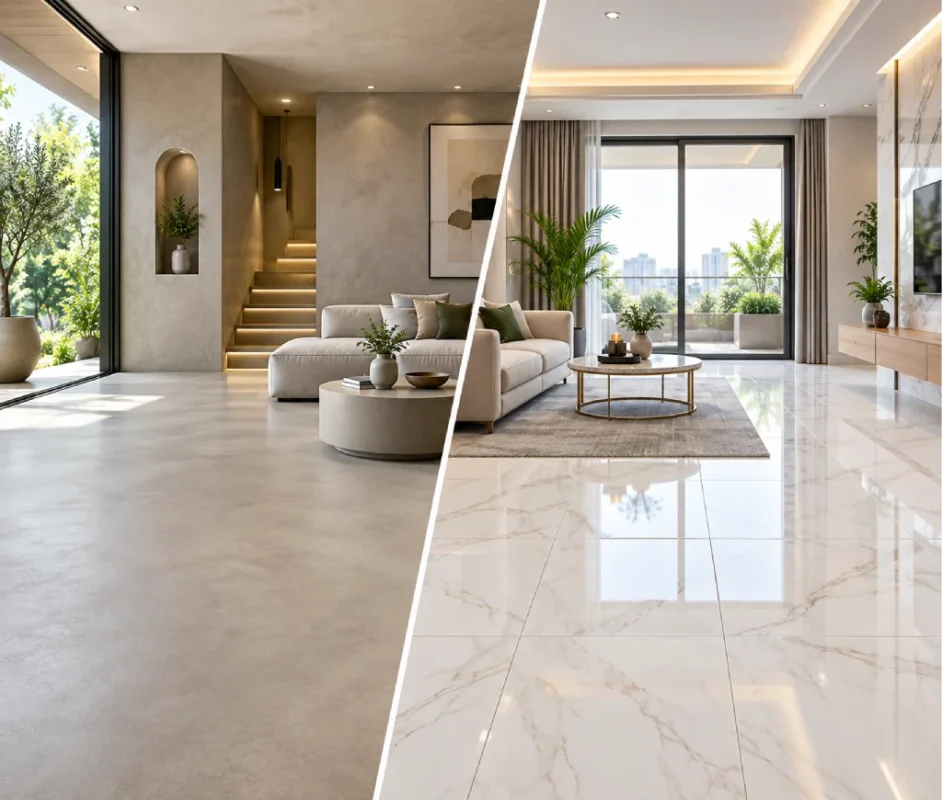
- Microcement
- Natural textures
- Mineral finishes
- Earth-inspired colours
- Sustainable construction materials
- Hand-applied wall finishes
For Pune homes, these materials can combine visual character with functional considerations such as moisture management and material compatibility.
This is especially relevant for homeowners who don’t want their interiors to look identical to conventional apartment finishes.
Final Verdict
When comparing lime plaster vs cement plaster, the best option depends on the building rather than a simple “one is better” answer.
Cement plaster offers strength, familiarity, availability, and reliable performance across many conventional construction applications.
Lime plaster, on the other hand, stands out for its breathability, flexibility, natural appearance, and sustainability potential. These characteristics can make it particularly attractive for traditional buildings, moisture-sensitive walls, restoration projects, and design-conscious homes.
For Pune’s changing climate, particularly the combination of heat and heavy monsoon moisture, understanding how a wall manages moisture is crucial.
If you’re looking for a cement plaster alternative that offers a more natural finish and better vapour permeability, lime plaster is certainly worth considering.
At Instakrete, the focus is on helping homeowners and designers explore modern surface solutions that combine aesthetics with practical performance. The right wall finish isn’t simply about making a surface look beautiful—it’s about choosing a material that works with the building, the environment, and the lifestyle of the people living in it.
Before selecting lime or cement plaster for your Pune property, evaluate the existing wall condition, moisture sources, substrate, desired finish, and long-term maintenance requirements. The right material, applied correctly, can make a significant difference to both the appearance and performance of your space.