
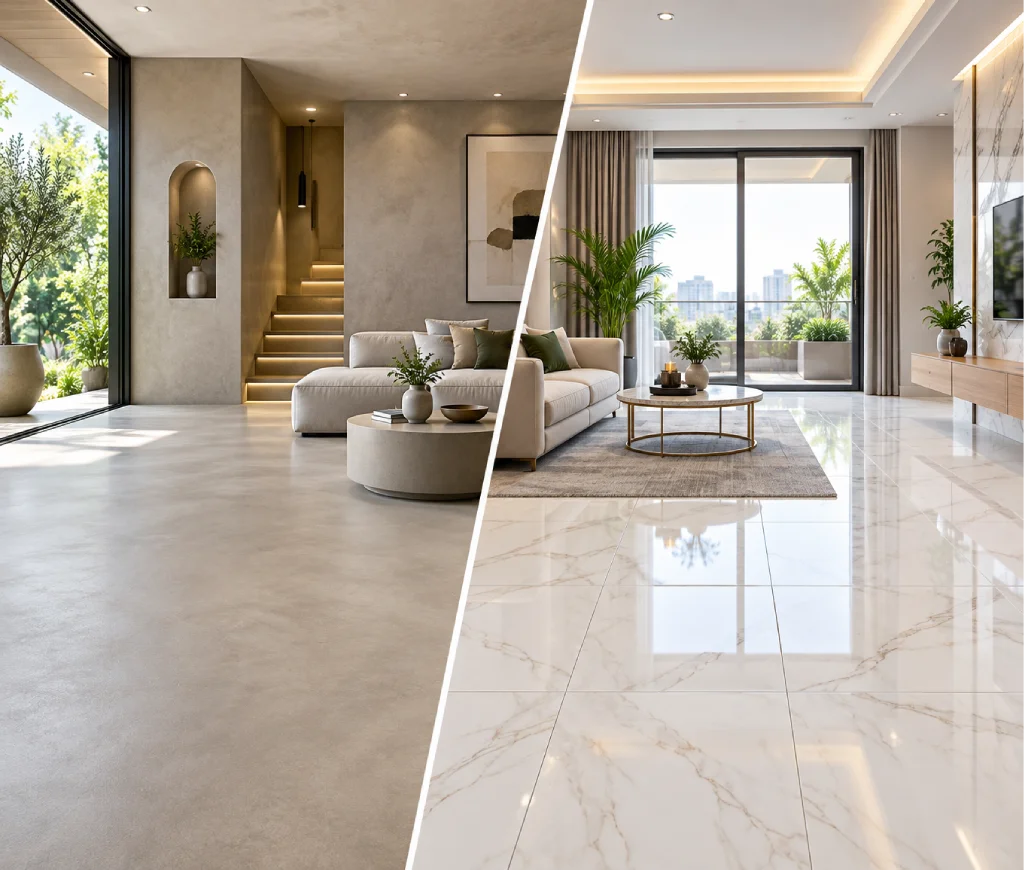
Choosing the right flooring can significantly influence the appearance, maintenance, and renovation experience of an Indian home. While vitrified tiles have remained a popular flooring choice for decades, microcement and microtopping are becoming increasingly attractive for homeowners who want a seamless, contemporary finish.
But when it comes to microcement vs tiles, which option actually makes more sense?
The answer depends on your priorities. Tiles offer familiar installation methods, extensive design choices and easy replacement of individual pieces. Microcement, on the other hand, creates a continuous surface with minimal visual interruption and can be particularly useful during renovations where removing an existing floor is undesirable.
Let us compare both options across appearance, installation, maintenance, durability and renovation requirements.
Microcement vs Tiles: Understanding the Difference
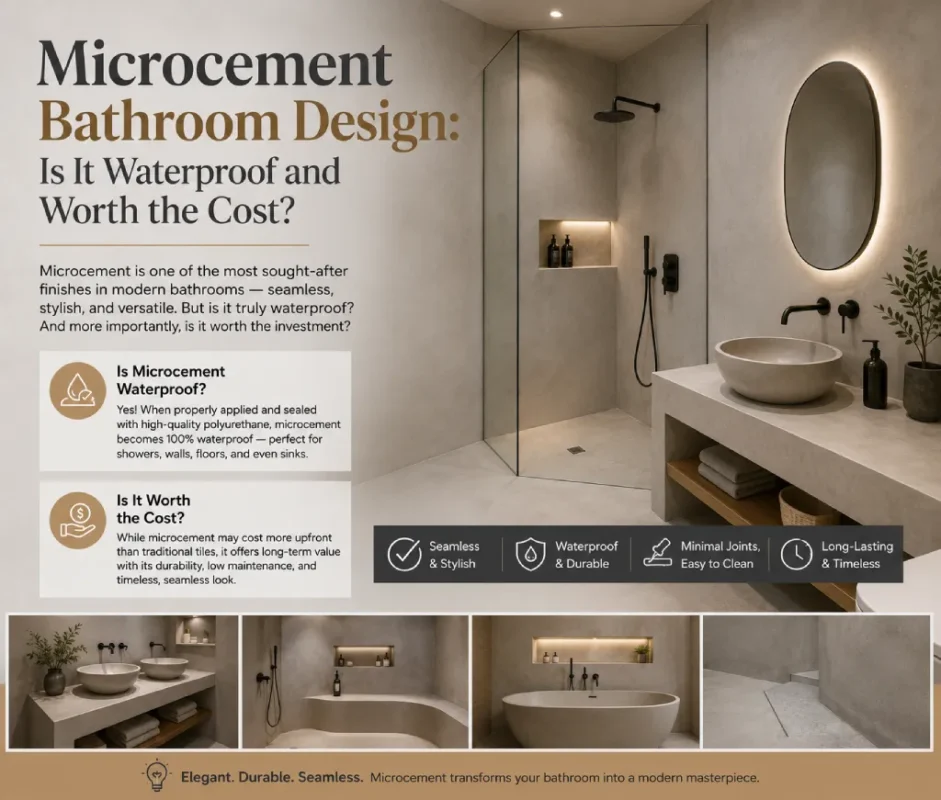
Microcement is a thin cement-based decorative coating applied in multiple layers over a properly prepared substrate. Unlike conventional flooring materials, it does not require individual pieces or visible grout joints. InstaKrete’s microcement flooring system is designed as an ultra-thin interior flooring solution and can be applied over suitable existing surfaces such as tiles and marble.
Tiles, including ceramic and vitrified tiles, are manufactured individual units installed over a prepared base using adhesive and finished with grout joints. They are available in a wide variety of sizes, colours, textures, patterns and finishes.
The biggest visual difference is simple: tiles create a structured surface with joints, while microcement creates a continuous, joint-free appearance.
1. Seamless Look vs Grout Lines
One of the strongest reasons homeowners consider microcement is its seamless appearance.
Traditional tiles require grout lines between individual pieces. Even with large-format vitrified tiles and narrow joints, the flooring remains visually divided. Over time, grout may also require additional cleaning and maintenance.
Microcement creates a continuous surface without conventional tile joints. This can make rooms appear visually larger and more open, particularly in minimalist interiors. The absence of grout lines also means fewer narrow areas where dirt and residue can accumulate.
For homeowners looking for a seamless flooring vs tiles comparison, microcement has a clear aesthetic advantage when a continuous surface is the priority.
2. Microcement Over Existing Tiles Can Simplify Renovation
Renovating an existing home often involves more than choosing a new finish. Removing old tiles can mean demolition, debris disposal, surface preparation and additional labour.
A major advantage of microcement is the possibility of using it as a renovation overlay over suitable existing tiles or other sound surfaces. However, the existing substrate must be properly assessed, prepared, levelled and bonded before application. InstaKrete also highlights application over existing tile and other flooring materials as one of its microcement flooring applications.
This approach can potentially reduce demolition work and construction waste compared with completely removing an existing floor.
Tiles can also be installed over an existing tiled floor in certain situations, but the existing surface, levels, bonding and installation system need to be evaluated before proceeding.
3. Cost: Look Beyond the Material Price
It is tempting to compare only the price per square foot of microcement and tiles. However, the actual renovation cost depends on the complete installation process.
With a new tiled floor, the total cost may include the tiles, adhesive, grout, labour, skirting, removal of an old floor and disposal of construction waste if demolition is required.
Microcement involves specialised preparation, multiple application layers and protective finishing. Although its material and installation cost can be higher than basic tiles, an overlay application may reduce some demolition-related expenses.
Therefore, demolition cost saving can become an important factor when comparing microcement with a complete tile replacement during renovation.
The right comparison is not simply “microcement price vs tile price.” Instead, compare the complete installed cost, including substrate preparation, demolition, waste removal, installation and finishing.
4. Durability and Everyday Use
Both microcement and vitrified tiles can provide durable flooring when correctly selected and professionally installed.
Vitrified tile is a familiar choice for Indian homes because of its hard surface, broad availability and resistance to everyday wear. Damaged tiles can also generally be replaced individually if matching pieces are available.
Microcement is designed as a durable surface system, but its long-term performance depends heavily on the quality of the substrate preparation, application system and protective sealer. Poor surface preparation can lead to problems such as cracking, peeling or uneven finishes.
This is particularly important when considering substrate movement. Microcement is a thin finish, so movement or instability in the underlying surface must be addressed before application.
For either flooring system, professional installation is essential for achieving the expected performance.
5. Maintenance: No Grout Does Make a Difference
Maintenance is another important consideration when choosing between microcement or vitrified tiles.
Tiles themselves are generally straightforward to clean, but the grout between them can require additional attention. Dirt, stains and moisture can accumulate around grout lines, especially in frequently used areas.
Microcement eliminates conventional grout lines, creating a smoother and easier-to-clean surface. InstaKrete describes its microcement flooring as low-maintenance and highlights its seamless finish as one of its key advantages.
However, “low maintenance” does not mean “maintenance-free.” Microcement relies on its protective finishing system, so homeowners should follow the recommended cleaning and maintenance practices for the specific system used.
6. Design Flexibility
Tiles offer almost unlimited design possibilities. Homeowners can choose marble-look vitrified tiles, wood-look tiles, patterned tiles, terrazzo designs, stone textures and numerous other styles.
Microcement offers a different kind of design flexibility. Rather than depending on individual tile patterns, it creates a continuous finish with variations in colour, texture and application technique.
This makes it particularly suitable for contemporary, minimalist and modern interiors where visual continuity is important.
Microcement can also visually connect different areas of an interior because the same finish can continue across multiple surfaces.
7. What About Slip Resistance?
Flooring should not be selected on appearance alone, particularly in bathrooms, balconies, utility areas and other places exposed to water.
Tiles are available in a range of surface finishes, including textured and anti-slip textures, allowing homeowners to select products suited to different applications.
Microcement can also be finished with different textures and protective systems, but the exact slip resistance depends on the complete system, including the texture and sealer.
For wet areas, homeowners should therefore ask the installer about the recommended system, waterproofing, surface texture and slip-resistance requirements rather than assuming that either material is automatically suitable.
8. Thermal Expansion and Movement Matter
Indian homes experience seasonal temperature changes, and flooring systems need to accommodate movement appropriately.
Tiles are installed with joints and movement provisions as required by the installation design. Extremely narrow joints or incorrect installation can create problems when movement is not adequately accommodated.
Microcement does not use conventional tile joints, but that does not mean the substrate can move freely underneath it. Because it is a thin overlay, proper substrate stability and preparation are particularly important.
In other words, a joint-free surface does not eliminate the need to consider thermal expansion, movement and structural conditions.
Microcement vs Tiles: Quick Comparison
| Feature | Microcement | Vitrified Tiles |
| Appearance | Seamless, contemporary and continuous | Wide range of designs with visible joints |
| Grout lines | No conventional grout lines | Required between tiles |
| Renovation overlay | Can be applied over suitable existing surfaces | Tile-over-tile may be possible depending on conditions |
| Demolition | Can potentially reduce demolition | May require removal of existing flooring |
| Maintenance | Low maintenance with correct finish | Easy to clean but grout needs attention |
| Design | Custom colours, textures and finishes | Very wide range of ready-made designs |
| Repairs | Repairs may require skilled blending | Individual tile replacement is possible |
| Installation | Requires specialist application | Widely available installation expertise |
| Slip resistance | Depends on texture and protective system | Available in various anti-slip finishes |
| Substrate requirements | Stable, sound and properly prepared | Properly prepared base required |
So, Microcement or Tiles — Which Should You Choose?
There is no universal answer to the microcement vs tiles debate.
Tiles can be a practical choice when you want a familiar flooring system, extensive product availability, a broad range of designs and the ability to replace individual damaged pieces.
Microcement can be particularly attractive when your priority is a seamless, minimalist appearance, fewer grout-related maintenance concerns and a renovation-friendly overlay system. It is especially worth considering when you want to transform an existing floor without automatically committing to extensive demolition.
For homeowners planning a renovation, the condition of the existing substrate should be one of the first considerations. A stable, properly prepared surface can make an overlay system practical, while movement, moisture problems, loose tiles or structural issues may require corrective work before any new finish is applied.
Is Microcement Suitable for Indian Homes?
Yes, microcement can be suitable for Indian homes when the appropriate system is selected and professionally installed. Its thin profile, seamless appearance and ability to work over suitable existing surfaces make it particularly interesting for modern renovations. InstaKrete offers microtopping flooring and bathroom solutions designed around seamless interior surfaces.
However, homeowners should avoid choosing microcement based only on photographs. The quality of the substrate, application process, protective coating, moisture management and installer expertise all influence the final result.
Final Thoughts
The choice between microcement and tiles ultimately comes down to how you want your flooring to look, perform and be installed.
If your priority is a joint-free surface, contemporary appearance and renovation overlay, microcement offers an interesting alternative to conventional flooring. If you prefer extensive ready-made designs, modular replacement and a familiar installation process, vitrified tiles remain a versatile option.
Before making a decision, compare complete installation systems rather than material prices alone. Consider the condition of your existing floor, expected usage, moisture exposure, slip resistance, maintenance requirements and long-term repair needs.
For homeowners looking to create a modern, seamless interior without automatically removing an existing floor, microcement can be a practical and visually distinctive flooring solution.
Looking for a seamless flooring solution for your home? Explore InstaKrete’s microcement and microtopping flooring solutions for modern interior renovations.